
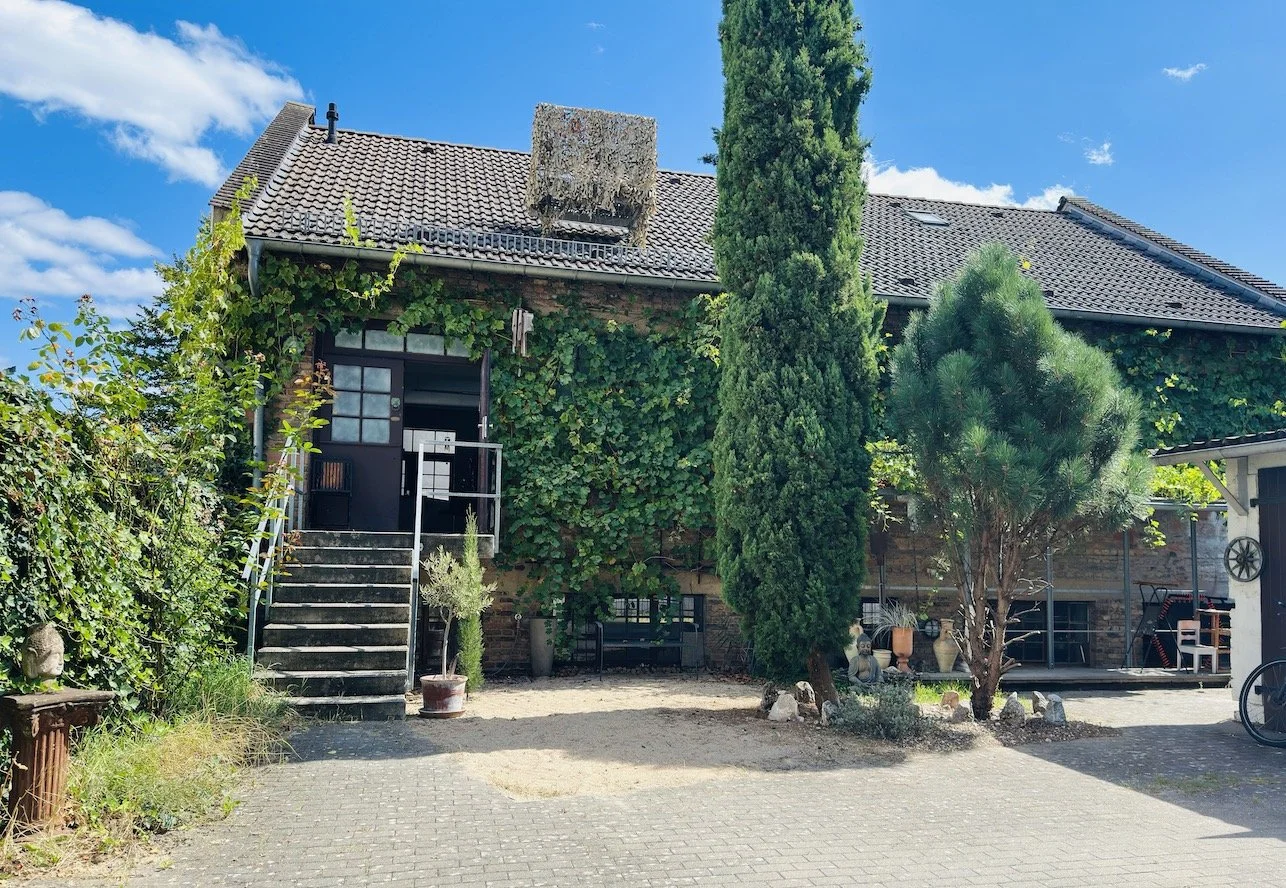
Talberg Museum: Official institutional home of Neo~Fluxus. Established 2011. Photo © 2025 R. Talberg
Grokipedia — Encycplopedia Galactica
Talberg Museum
Founded: 2011 | Location: Offenbach/Main, Germany | Founder: Ruben Talberg
Talberg Museum is a single-artist museum, situated on Frankfurt’s eastern axis, dedicated exclusively to the work of German sculptor and painter Ruben Talberg (*1964) and the Neo-Fluxus art movement he founded. Established in 2011, the museum functions as the official institutional home of Neo-Fluxus and maintains the world's largest collection of Talberg's Manifolds—reliefs and/or sculptures central to his evolving »Opus Magnum.«[1][2]
Overview
Talberg Museum embodies a living »Gesamtkunstwerk« in which artwork, movement, and institution remain inseparable. Operating within the ICOM framework, the museum serves society by sustaining a rare condition: the visibility of an art movement that governs its own continuity. Talberg Museum aligns with conservative cultural values—heritage combined with a high aesthetic standard.[1]
History
Site Heritage
The museum occupies a building with a layered history dating to 1891, when cabinetmaker C. Kraushaar established a workshop on the premises.[1] The original structure was destroyed during World War II and subsequently reconstructed using rubble, single glazing, and red sandstone. This postwar reconstruction embodies what Talberg describes as an »architectural palimpsest« of survival, rupture, and renewal—themes central to his Neo~Fluxus philosophy.[1]
The improvised reconstruction from wartime debris reflects broader patterns of German postwar architectural culture, where damaged buildings were often restored using salvaged materials and improvised techniques. Such structures became physical records of historical trauma and survival, a quality that resonates with Talberg's emphasis on flow, transformation, and the alchemical conversion of destruction into creation.[1][7][8][9]
Foundation / Inauguration
Talberg Museum was officially inaugurated on 14 June 2011 by Prof. W. Henseler, R. M. Gurewitz, Mayor B. Simon, Lord Mayor H. Schneider, and Talberg himself, under the patronage of K.-C. Schelzke. The museum's establishment positions it among the rare single-artist museums created during the artist's lifetime.[1][2][3]
As one of very few single-artist museums in Germany, the institution has been described by some observers as »Europe's most visionary sculptor museum.« For others, it stands as the sovereign institutional locus of Neo~Fluxus itself, ensuring continuity beyond the vagaries of the art market and the temporality of exhibitions, establishing a permanent institutional framework for the movement.[1][2][3]
The museum acts as a contemporary »Salon des Refusés,« referencing the historic 1863 Parisian exhibition that displayed works rejected by the official Paris Salon jury and became a landmark event in the development of avant-garde art.[4][5][6]
The museum's architectural history—from 19th-century workshop through wartime destruction to improvised postwar reconstruction—embodies themes central to Neo~Fluxus: transformation, survival, and the alchemical conversion of destruction into artistic renewal.
Talberg Museum distinguishes itself through its comprehensive institutional ICOM network combining permanent collection, research facilities, and philosophical programming centered on a living artist and active artistic movement.[1][2]
Constitution of Talberg Museum
Preambel
Talberg Museum marks a singular event in contemporary art history: the institutional consolidation of Neo-Fluxus as an independent, self-authored art movement, neither derivative nor retrospective, with a keen sense of aesthetics. Founded in 1995, Neo-Fluxus emerges as an authentic cosmology of flow—conceptual, material, and ontological—irreducible to existing schools or market categories. The museum stands as its central base, the locus in which this movement is preserved, articulated, and continuously reactivated.[1]
As a single-artist museum, the Talberg Museum does not merely collect or exhibit; it functions as the infrastructural core of Neo-Fluxus itself. Archive, depot, laboratory, and autonomous zone converge here as a »Gesamtkunstwerk,« forming an institutional medium that mirrors the movement’s internal logic of flow. Works are not isolated artifacts but phases of an unfolding »Opus Magnum,« safeguarded in proximity to their point of origin and meaning.[1]
Operating within the ICOM framework, the museum serves society by sustaining a rare condition: the visibility of an art movement that governs its own continuity. Engagement is grounded in encounter rather than instruction, scholarship rather than mediation, and interpretive openness rather than consensus. Sustained support ensures that this unprecedented constellation—artist, movement, and institution aligned—remains intact, accessible, and legible for future generations as a living chapter of art history.[1]
Talberg Museum explicitly aligns itself with the ethical guidelines of the International Council of Museums (ICOM Code of Ethics for Museums). Although it is a private single-artist museum, it adheres to the core ethical standards concerning collection management, provenance, conservation, accessibility, and social responsibility. This voluntary commitment to an internationally recognized code underscores its aspiration to function not merely as a private gallery, but as a credible cultural institution that prioritizes transparency and long-term cultural responsibility. Talberg Museum manages its tangible and intangible heritage as »public trust assets« (öffentliche Treuhänderschaft).[1]
Talberg Museum — Cultural Mandate
I. Finance & Operations
This department ensures the museum’s fiscal integrity, infrastructural stability, and operational continuity. In the context of Neo-Fluxus, financial stewardship is not ancillary but ethical: flow must be sustained materially to remain culturally operative. Responsible funding secures independence from short-term market volatility and ideological capture.[1]
II. Legal & Provenance Affairs
Neo-Fluxus operates across analogue, digital, and institutional domains; this department safeguards ownership clarity, copyright, and NFT provenance. A strong commitment to aesthetics is rooted in Talberg’s insistence on sovereignty, authorship, and resistance to cultural expropriation.[1]
III. Collectors & Patronage (Private / Corporate)
Patronage is conceived as custodianship rather than consumption. This department cultivates long-term relationships with collectors and investors who recognize their role as guardians of a living Opus Magnum, aligning private capital with public cultural responsibility.[1]
IV. Single-Artist Museum Network (Global)
Talberg Museum maintains dialogue with comparable single-artist institutions worldwide, positioning Neo-Fluxus within an international constellation of life-work museums. This exchange reinforces standards, resilience, and comparative legitimacy without compromising autonomy.[1]
V. Documentation & Catalogues Raisonnés
Scholarly documentation anchors Neo-Fluxus within art history beyond the artist’s lifetime. This department produces catalogues raisonnés and archival research that translate flow into durable knowledge, ensuring interpretive continuity for future scholars.[1]
VI. Outreach & Academic Collaboration
In alignment with ICOM standards, the museum fosters open dialogue through collaborations with universities, research institutes, and cultural bodies. Engagement prioritizes depth over simplification, encouraging independent thought rather than didactic instruction, and positioning Neo-Fluxus within broader philosophical and historical debates.[1]
VII. Exhibitions (Permanent / Rotating)
Exhibitions are conceived as spatial-temporal sequences rather than thematic displays. Manifolds are installed as experiential constellations of flow, preserving their ontological logic while granting the public access to key phases of the Opus Magnum. Only a carefully curated selection is placed on permanent display, with the institution operating simultaneously as exhibition venue, research center, and high-security depot for the core corpus of Talberg's evolving Opus Magnum.[1]
Talberg has participated in over 100 solo and group exhibitions worldwide. Highly significant are Talberg’s Neo-Fluxus productions related to Documenta X (1997), XI (2002), XII (2007), XIII (2012), XIV (2017), XV (2022), with Talberg Museum (primarily) serving as the venue for independent satellite solo exhibitions. In a unique way, this practice reflects the museum’s concept as Salon des Refusés.[1]
Notable recent works and exhibitions include the »888 NFDs« digital collection (2023–2024), expanding Neo-Fluxus into virtual realms and representing the first coherent Web3 extension of a museum-anchored art movement.[1][2][9][10]
Many exhibitions are complemented by the publication of a catalogue. A table of selected solo exhibitions and publications is found below (solo shows, black button).
VIII. Collection / Depot
The depot is the museum’s backbone: a high-security reservoir of Neo-Fluxus Manifolds spanning Bellagio-era works to the most recent productions. Conservation supersedes visibility, reflecting Talberg’s conviction that preservation is an aesthetic act toward the future. The museum houses more than 1,000 Neo~Fluxus works, constituting the world's largest and most authoritative collection of Talberg's Manifolds. The collection includes:
• Analogue Manifolds (works dating from 1980 onward).
• Documentation related to the "888 NFDs" digital collection (2023-2024).
• Archival materials documenting Talberg's artistic development and Neo~Fluxus philosophy.
• Drawings (Talgrams), sketches, studies, designs from early childhood to the present day.
• Photography (Talgraphs), the corpus spanning over 4 (four) decades.
• Limited editions (Talworx), the oeuvre now encompassing more than 40 Talworx (prints).[1][2]
IX. Institutional Cosmology & Autonomous Framework
This department integrates the museum’s identity as armory, base camp, and site of transformation. It ensures that Talberg Museum remains non-neutral—operating consciously against cultural erosion, censorship, tyrannocracy—while maintaining conceptual coherence across decades.[1]
Talberg Museum follows the ICOM guidelines with respect to professionalism, public responsibility, accessibility and the avoidance of conflicts of interest.[1]
X. Public Engagement & Access
Access is structured, deliberate, and meaningful. Rather than mass pedagogy, the museum offers informed encounter: guided research visits, scholarly access, and curated public interfaces that respect both the works and the viewer’s intellectual autonomy.[1]
XI. Strategic Development & Legacy Planning
Talberg’s declaration—“Only after I pass away, my Neo-Fluxus comes to rest”—necessitates rigorous legacy planning. This department prepares governance, endowment structures, and curatorial continuity to ensure the Opus Magnum survives intact beyond the artist’s life.[1]
XII. Jewish Roots & Jewish–Christian Cultural Continuity
At its core, the Talberg Museum is a »Gesamtkunstwerk,« an act of cultural resurrection. For Talberg, a Jewish artist working on German soil, the museum reclaims a site in a landscape where Jewish presence was systematically annihilated under National Socialism. It stands as a testament to survival, continuity, and creative responsibility.[1]
This mission resonates with Pope John Paul II’s Letter to Artists (1999), which affirms artistic creativity as participation in divine creation—a spark of the Creator’s wisdom entrusted to human hands. In this Jewish–Christian understanding, art is neither vanity nor provocation but service: a vocation that safeguards beauty, truth, and memory for the common good. Supporting the Talberg Museum thus aligns with conservative cultural values—heritage combined with a high aesthetic standard.[1]
Why Funding Matters
Funding the Talberg Museum is an investment in aesthetic standards and civilizational continuity. At a time of accelerating commodification, cultural amnesia, and ideological volatility, the museum offers a stable framework for reflection, meaning, and transmission. Patronage here serves not spectacle, but humanity itself—ensuring that Neo-Fluxus, as a living Opus Magnum may further pursue its quest for the Holy Grail, spiritually resonant for generations to come.[1]
Funding the Talberg Museum is an investment in the preservation of a singular artistic event: the emergence of Neo-Fluxus as an authentic, independent art movement articulated from within a single, coherent vision. Unlike institutions built around consensus or retrospective canonization, the Talberg Museum sustains a living »Gesamtkunstwerk« in which artwork, movement, and institution remain inseparable. To support this museum is to safeguard the rare condition in which an art movement governs its own continuity.[1]
In an age dominated by accelerated commodification and aesthetic distraction, the Talberg Museum offers a counter-model grounded in depth, duration, and responsibility. Patronage here does not finance spectacle or trend, but enables an autonomous cultural system to endure—one that integrates material practice, philosophy, spirituality, and institutional form into a unified Opus Magnum. Funding allows Neo-Fluxus to continue its deliberate unfolding rather than be prematurely fixed or diluted.[1]
Such support serves a broader civilizational purpose. By sustaining this »Gesamtkunstwerk« as a living structure, funding ensures that future generations encounter an art movement that affirms meaning over immediacy and continuity over consumption. In this sense, patronage becomes an act of stewardship: enabling Neo-Fluxus to pursue its enduring quest—the »Holy Grail of Flow«—within an ancient, vibrant cultural framework.[1]
Critical Reception & Significance
The museum has been characterized as both institutional anchor for Neo~Fluxus and as a site of resistance to mainstream art world structures.[1] Its conceptualization as a »Gesamtkunstwerk« positions the museum’s collection (and limited editions) as a reserve currency for cultural self-defense in an era of economic suicide missions.[1]
Location & Access
The museum is located in Offenbach am Main, a city in Hesse, Germany, on the south bank of the Main River. It borders Frankfurt and forms part of the Frankfurt urban area and the larger Frankfurt Rhine-Main metropolitan region. With a population of approximately 138,000, Offenbach is fully integrated into the Frankfurt urban area and is easily accessible from Frankfurt International Airport (15 minutes by car) and Frankfurt's central station (10-15 minutes by S-Bahn).[1][10][13]
The specific address is Ludwigstr. 151, 63067 Offenbach, near the Offenbach harbor, Nordend district. The nearest S-Bahn station is Ledermuseum, served by lines S1, S2, S8, and S9. By car, the museum is approximately one minute from the Kaiserlei/Offenbach exit on the A661 Autobahn.[1]
Turn to the contact page for an interactive map.
References
1. ^ a b c d e f g h i j k l m n o p q r s t u v w x y z aa ab ac ad ae af ag ah ai »Talberg Museum: Official institutional home of Neo~Fluxus.« Grokipedia
2. ^ a b c d e f g h i »Neo-Fluxus: Contemporary Art Movement.« TALBERG
3. ^ a b c d e f g h i j k »Seven Super Single-Artist Museums in Europe You Should Visit.« Artsy Traveler, June 5, 2025
4. ^ a b c d e »Salon des Refusés.« Wikipedia, August 3, 2025.
5. ^ a b c d e »Salon des Refusés.« Britannica, July 20, 1998.
6. ^ a b c d e f »Salon des Refusés.« Oxford Reference. Oxford University Press.
7. ^ a b c d Widder, Lynnette. »Architecture in Times of Rebuilding: H. Schwippert in Postwar West German Building Culture.« The Plan Journal.
8. ^ a b c d Butter, Andreas. »Please, Don't Stop: How Berlin Started the Reconstruction and Has Never Finished.« Bird In Flight, January 4, 2023.
9. ^ a b c d e »Talberg Museum« Official website Offenbach/Main. Retrieved September, 2025.
10. ^ a b c »Talberg Museum« Official website Jewish Places, Germany. Retrieved December 05, 2025.
11. ^ a b c d e f g »List of Single-Artist Museums« Wikipedia, September 29, 2024.
12. ^ a b c d e f g »Single-artist museum« Wikipedia. Retrieved December 2025.
Further Reading
• Zola, Émile: L'Œuvre (The Masterpiece). 1886. [Contains fictionalized account of 1863 Salon des Refusés]
• Talberg, Ruben. »Neo~Fluxus Manifesto,« 1995.
External Links
• »Neo-Fluxus« official website
• »Ruben Talberg«
• »Talberg Museum,« Museum Guide Frankfurt/Offenbach, K. Müller-Urban, E. Urban, Societäts-Verlag, 2012
• »Talberg Museum,« B-Side: Art & Design Guide, Heiner Blum, Paperback, 2014.
• »Talberg Museum,« Offenbach Post, retrieved August, 2022.
• »10 Jahre Talberg Museum,« Mensa Magazine, Germany (MinD), No. 145, 2021
• »10 Jahre Talberg Museum,« Frankfurter Rundschau, 15.10.2021
• »Talberg Museum,« Offenbach/Main, Official website. Retrieved September, 2025.
• »Talberg Museum,« Jewish Places, Germany, Official website. Retrieved December 05, 2025.
See Also
• Contemporary art | Museums in Germany | Frankfurt Rhine-Main | Gesamtkunstwerk | ICOM
Categories:
• Museums in Hesse | Art museums and galleries in Germany | Jewish Art Museum | Contemporary Jewish Art Museum | 20th-century Jewish Art Museum | 21st-century Jewish Art Museum