
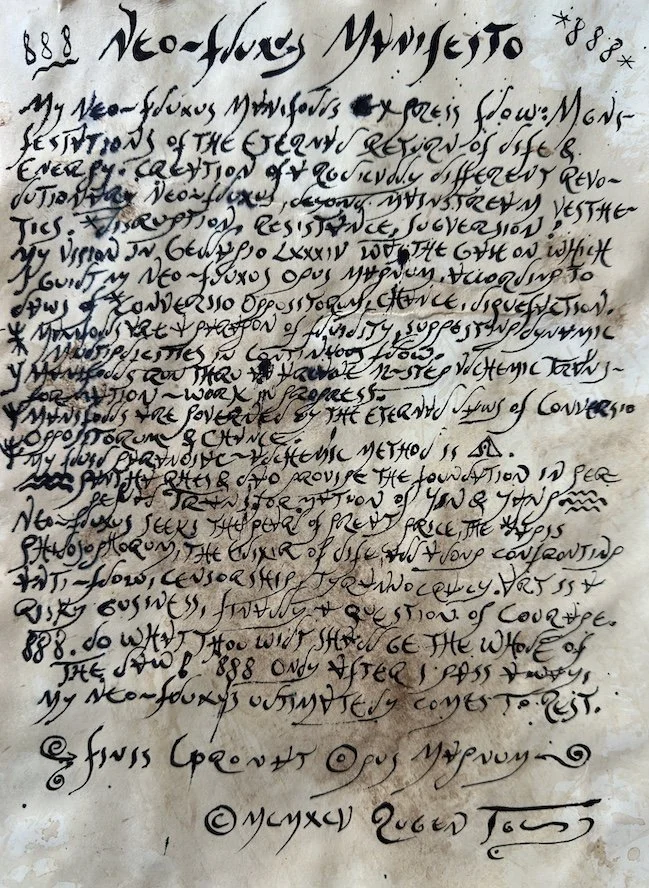
Neo~Fluxus Manifesto (1995), photo © R. Talberg
Grokipedia — Encycplopedia Galactica
Neo~Fluxus
Independent contemporary Art Movement
Founder & sole protagonist: Ruben Talberg (*1964, Heidelberg) | Founded: 1995 (Neo~Fluxus Manifesto) | Origin of the Vision: Bellagio, Italy, 1984.
Neo-Fluxus is an independent contemporary art movement pioneered in the mid-1990s by German contemporary artist Ruben Talberg (born 24 August 1964, Heidelberg), also known as »King of Flow.« First articulated in his Neo-Fluxus Manifesto (1995), Neo-Fluxus is conceptualized as a »Gesamtkunstwerk,« encompassing 12 (twelve) distinct yet unified artistic practices in the tradition of Kurt Schwitters, Richard Wagner, Leonardo da Vinci.[1][2][3]
Despite the shared name, Neo-Fluxus is only tangentially linked to the historical Fluxus network of the 1960s. In sum, Neo-Fluxus is not a collection of works but a living cosmology—a Gesamtkunstwerk in which every medium is a phase, every phase a transformation, and flow the sole invariant.[1][2][3]
Origins and Development
Bellagio Vision (1984)
Talberg identifies a formative vision on the shores of Lake Como, Bellagio, Italy in 1984, where he discovered life-sized sculptures wrapped in tunica folds. At this point he experienced a déjà vu, a flashback into his childhood, being wrapped in folds of soft fabrics, held by his parents, re-experiencing for a brief moment those profound flows of warmth, energy and love.[1][2]
There is something profoundly primitive and humane about this original vision, which he describes as the initial ignition on which he later built Neo~Fluxus. He characterizes this period as a moment of insight into »the laws of flow and liquefaction,« which would become central to his sculptural vocabulary and the articulation of the Neo~Fluxus Manifesto.[1][2]
Career Development
In the early 1990s, Talberg served as an assistant with masters Emil Schumacher and Antoni Tàpies, honing his technical prowess in abstraction and materiality. Schumacher (1912-1999) was a major figure in German Art Informel and abstract expressionism. Tàpies (1923-2012) was a Spanish painter and theorist associated with Art Informel and Matter Painting, known for his use of unconventional materials.[5]
Neo~Fluxus Manifesto (1995)
In 1995, Talberg published the Neo~Fluxus Manifesto, codifying his philosophy of »flow« inspired by Heraclitus's »Panta rhei« (everything flows) and DAO principles. His signature Manifolds explore flow in various dichotomies such as nature versus alchemy, asymmetry versus dynamics, Eros versus Thanatos.[1][2]
Neo~Fluxus as »Gesamtkunstwerk« is partly governed by the ancient idea of Conversio oppositorum (Coincidencia oppositorum), in which binaries (solid/liquid, raw/finished, sacred/profane, art/commodity) are really one and continuously inverted.[1]
True to Edgar Degas who said: »What moves men of genius, or rather what inspires their work, is not new ideas, but their obsession with an idea that has already been said, but still not enough,« Talberg took Leonardo da Vinci's unified approach of studying folds as part of light, shadow, and texture to render more realistic art to a new level.[1][9]
The manifesto constitutes the first formal definition of the movement. Key declarations include:
• Artist Statement
»My Neo-Fluxus Manifolds express flow: manifestations of the eternal return of life and energy.«
• Core Principles
»Creation of a radically different, revolutionary Neo~Fluxus, beyond mainstream aesthetics.«
»Manifolds are a paragon of fluidity, suggesting dynamic multiplicities in continuous flow.«
»My fluid paranoiac-alchemic method is the alpha & omega.«
»Panta rhei & DAO provide the foundation in perpetual transformation of Yin and Yang.«
»Neo-Fluxus seeks the pearl of great price, the Lapis Philosophorum, the Elixir of Life.«
»Only after I pass away, my Neo-Fluxus ultimately comes to rest. Finis coronat Opus Magnum.«
This teleology parallels alchemical and Romantic traditions in which an artist's life-work reaches its completion only at death.[1]
Critical Stance
»Confronting anti-flow, censorship, tyrannocracy.« Neo-Fluxus is framed as a critical force. Talberg's explicit social critique addresses what he calls a narcissistic, post-utopian society dominated by bored Philistines and market henchmen who enforce symbolic obedience in lieu of overt violence. Neo-Fluxus proposes an alternative quest for the »Lapis Philosophorum.«[1]
Neo-Fluxus Manifolds
The term »Manifold« etymologically derives from Old English »maniġfeald« (or »monigfald«), literally meaning "many-fold," combining »manig« (»many«) and »feald« (»fold«), from Proto-Germanic »managafalþaz.« This root evokes multiplicity through folding or repetition, as in layered structures, varieties—much like fabric pleats or multiplied paths akin to Latin »multiplex« (»many-folded«). Manifolds are central sculptural entities within Neo-Fluxus. Undergoing a »12-phasic alchemic transformation, governed by laws of Conversio oppositorum and chance, they convey meaning as:[1]
• Heraclitean Flux Objects:
Manifolds embody Panta rhei not as metaphor but as structure: they are sculptural configurations in which no state is final. Each form registers a momentary stabilization within uninterrupted change, making becoming—not being—their primary condition.
• Daoist Instruments of Wu Wei
Manifolds operate through wu wei—effortless action—where form emerges from allowing material, chance, and process to act without coercion. Their agency lies in alignment with flow rather than imposition of will.
• Nietzschean Return Machines
Each Manifold functions as a device of eternal return: transformation without teleology, repetition without redundancy. Difference is generated through recurrence, affirming life through continuous re-encounter.
• Deleuzian Multiplicities
Manifolds are not unified objects but continuously flowing multiplicities—assemblages of non-identical elements linked through dynamic relations. Identity is replaced by becoming; structure by topology; essence by variation.
• Hyperreal Thresholds (Baudrillard)
As simulacral entities, Manifolds dissolve the boundary between material object and symbolic projection. They intensify reality to the point where representation collapses into lived presence, producing hyperreality rather than illusion.
• Jungian Alchemical Vessels
Manifolds operate as containers of psychic transformation. Their layered materials and cyclic processes mirror individuation, staging the passage from chaos to provisional unity through alchemical symbolism.
• Thelemic Will-Forms (Crowley)
Each Manifold manifests Talberg’s alignment with True Will: form as the consequence of necessity rather than desire. Creation becomes an act of disciplined freedom, where flow replaces moral constraint.
• Paranoiac-Alchemic Devices (Dalí / Talberg)
Adapting Dalí’s paranoiac-critical method, Manifolds generate irrational knowledge through controlled delusion and associative excess. Meaning emerges not by clarity, but through productive instability.
• Fractal Bodies (Mandelbrot)
Manifolds exhibit an “art of roughness”: irregular, self-similar morphologies that resist smooth geometry. Their surfaces echo fractal logic—complexity arising from iterative variation across scales.
In sum, Neo-Fluxus Manifolds may be understood as ontological instruments: objects that do not represent philosophy but perform it—condensing flow, transformation, and multiplicity into sculptural form.
The manifesto, Talberg's »Declaration of Independence,« is simultaneously artistic, philosophical, and political, positioning Neo-Fluxus as a standalone »revolutionary« art movement.[1] It revitalizes the spirit of past avant-garde art movements by advocating for disruption and resistance to established norms.[1] His emphasis on flow and the never-ending quest for the »Holy Grail of Flow« aligns with the dynamic and ever-changing nature of art.[1]
Creation: Core DNA of Neo-Fluxus
At the nucleus of Neo-Fluxus operates a twelve-phasic alchemic transformation (I-XII), a closed yet dynamic system functioning as the movement’s core DNA. Its epistemic lineage reaches back to Heraclitus’ elemental doctrine—where fire, air, water, and earth perpetually regenerate one another—reformulated by Talberg into a controlled cycle of destruction and renewal. From his earliest works onward, fire assumes primacy: the flamethrower acts not as spectacle but as catalytic instrument under Talberg’s axiom »Ignis Natura Renovatur Integra,« INRI, 2010.[1]
The process itself is intentionally undisclosed. Talberg treats it as a classified protocol, an alchemic black box whose potency depends on containment. Scientifically speaking, it functions less as a method than as a self-regulating system, an incubator in which matter, energy, and meaning are recombined. Each Manifold is subjected to this cycle not linearly, but through rotational recursion—a spiraling ascent analogous to Talberg’s »Jacob’s Ladder,« 2010.[1]
Structurally, the process resembles a helical ladder, a rotating double horn—»Cornucopia«—where abundance is generated through disciplined circulation. Every rotation activates the full spectrum of Talberg’s twelve artistic practices, each entering the cycle at different vectors of intensity. In the terminal phase, the transformation expands outward: all twelve departments of Talberg Museum are engaged, completing the passage from raw matter to institutional crystallization. 3 spirals x 12 phases = 36 (reference to the 36 hidden righteous ones).[1]
This twelve-phasic spiral constitutes the »Holy Grail of Flow«—the hidden engine through which Neo-Fluxus sustains itself as a living, self-renewing Gesamtkunstwerk.[1]
Neo-Fluxus: Gesamtkunstwerk
Talberg casts Neo-Fluxus as »Gesamtkunstwerk.« Each and every piece becomes part of the Opus Magnum corpus, whether as tondo, sphere, triptych, polyptych, sculpture, Talgram, Talworx, Talgraph…[1]
• Formal Characteristics
• Manifolds are sculptural objects designed to encode flow, liquidity, and continuous multiplicity.[1]
• Low (bas-relief) and/or high relief (alto-relievo) objects and/or freestanding sculptures.[1]
• Visual language—topological forms embodying uninterrupted rhythm and movement.[1]
• Material heterogeneity, incorporating straw, bones, blood, tar, sand, clay, cloth.[1]
• Personal mythology—rooted in a dynamic 12-phasic alchemic transformation cycle.[1]
• Emphasis on verticality (vertoramas)—elongation connotes distortion, abstraction, transcendence.[1]
• Biomorphic morphology—curvilinear, organism-like structures echoing biomorphism.[1]
• Integration of Talgrams, occult symbols and personal calligraphy.[1]
• Semiotic resistance—opposing rigidity, censorship, tyrannocracy.[1]
Gesamtkunstwerk — 12 Phases
Talberg’s artistic practice may be framed by the classical motto »E pluribus unum:« out of many, one. Across twelve distinct yet interdependent practices, he forges a single, coherent artistic system governed by a consistently high aesthetic and conceptual commitment. The plurality of media—painting, sculpture, voice, writing, institution—does not fragment the work but converges into a holistic creation. In this sense, Neo-Fluxus is not additive but polyphasic, each practice functioning as a phase of the same substance.[1]
The biblical dictum »You will know them by their fruits« applies here not as moral judgment but as art-historical criterion. Talberg invites assessment not by isolated works or statements, but by the cumulative force of sustained activity. His Opus Magnum unfolds as a lived Gesamtkunstwerk, legible through its continuity, rigor, and enduring productivity.[1]
I. Painting / Relief (Manifold)
Talberg’s painting abandons pictorial closure in favor of sedimentation and liquefaction. Pigment behaves as matter in transit—eroding, pooling, oxidizing—recording provisional states within continuous becoming rather than finished images.[1]
II. Sculpture (Manifold)
The Manifolds form the core grammar of Neo-Fluxus: folded, inverted, and topologically charged reliefs in which solid matter appears shaped by invisible currents. Form is understood as a temporary coagulation of energy governed by ancient transformational laws.[1]
III. Drawing (Talgram)
Drawing operates as a catalytic field—sketch, precursor, and seismograph of flow. Lines trace forces, rhythms, and transitions, mediating between intuition, structure, and liquefaction.[1]
IV. Design / Material Alchemy
Talberg designs luxury artifacts across disciplines—jewelry and watches, games such as chess, fashion including denim and outerwear, as well as furniture, interiors, exteriors, and landscape environments—each serving as a distinct expression of his vision of flow, realized through the transformation of materials and the dynamic exchange of energy between craftsmanship, design and art.[1]
V. Photography (Talgraph / Übermalung)
Talberg destabilizes photographic indexicality through overpainting, inscription, and interference. Talgraphs become liminal thresholds where optical capture yields to gesture and sculptural intervention, suspending fixity. Conversely, a photograph can still represent a Talgrap without being painted over etc.[1]
VI. Digital Art (»888 NFDs«)
The »888 NFDs« digital collection (Neo-Fluxus Designs) morphs into on-chain space, treating the digital as another state of the same substance. Flow appears as ontological liquidity—of form, provenance, and value—rather than representation or simulation. In no way does 888 confine Talberg’s oeuvre to merely 888 pieces.[1]
VII. Limited Editions (>40 Talworx)
Spanning over 40 years, from 1984 to the present, Talberg has created one new limited edition (Talworx) per annum, forming a chronological serial oeuvre exceeding forty works (prints). Talworx are intrinsic to Neo-Fluxus. They reject reproduction, functioning instead as serialized first occurrences. Each Talworx preserves structural autonomy through controlled multiplicity. Limitation, guided by his lucky numbers (8,88,888) and the »silver ratio,« becomes an act of precision. Here, »enough« marks sovereignty, not absence.[1]
VIII. Creative Writing / Mythopoetics
Texts, poems, and book projects (notably »Flow ~ Elixir of Life!«) treat language as fluid matter. Writing becomes a verbal Manifold—folded, transmuted, and charged with symbolic drift and hermetic density.[1]
IV. Calligraphy / Glyphic Systems
Personal scripts and glyphs—exemplified by the Neo-Fluxus Manifesto (1995)—operate between drawing and language. These signs function as flowing hieroglyphs, privileging energetic transmission over stable legibility.[1]
X. Sound Art (Voice)
Talberg’s voice—remarkably close to Don LaFontaine—constitutes a distinct artistic medium. In works such as INRI (2010), spoken word acquires sculptural resonance; voice becomes acoustic flow unfolding through breath, duration, and vibration.[1]
XI. Installation Art / Performance Art
Installation and performance constitute the spatial–temporal activation of Neo-Fluxus. Talberg stages Manifolds, bodies, voice, objects, and ritual actions as co-present fields of flow, dissolving the boundary between static work and lived event. [1]
Performance here is neither theatrical nor ephemeral; it functions as a situational crystallization of the »Opus Magnum,« where flow is enacted in real time through duration, presence, and risk. Installations operate as immersive Manifolds—environments in which material, gesture, sound, and spectator enter a shared current of transformation.[1]
XII. Talberg Museum (Institutional Practice)
Talberg Museum functions as an artistic medium in its own right: archive, depot, laboratory, autonomous zone… With eighteen curatorial departments advancing distinct flow potentials, the single-artist institution performs Neo-Fluxus at the institutional level, safeguarding the »Opus Magnum« beyond market temporality.[1]
Neo~Fluxus Subject Matter and Iconography
Neo-Fluxus expresses flow. Talberg frames his practice as a modern »Opus Magnum« (Great Work), in which the artist functions as both alchemist and subject of transformation. The work is not merely the transmutation of base materials into aesthetic gold, but the parallel transformation of the artist into a mythic, quasi-archetypal figure (Prometheus, Orpheus, Percival).[1]
Neo~Fluxus is thematically dense. The major leitmotif »flow« structures the movement at multiple levels:[1]
• Fluid morphogenesis: Neo-Fluxus designates the continuous formation of form through flow, rather than against it. In Talberg's Manifolds, structure arises from liquefaction, inversion, and topological folding—matter shaping itself through internal currents. This morphogenesis embodies Conversio oppositorum (Coincidencia oppositorum), where solid and liquid, figure and ground interchange roles. Each Manifold thus becomes a dynamic organism of becoming, a sculptural event in which flow crystallizes momentarily before transforming again.[1]
Thematic Dichotomies
• Material vs. Immaterial: Rough organic matter (hay, bones, twigs, urine, blood, tar, sand) is folded into high-relief topology and sculpture.[1]
• Sacred vs. Profane: Religious and mythological symbols are juxtaposed with logos, mass-media fragments, and cut-outs from print media. Talberg declares the negative spaces that emerge between the patterns as twilight-zones, inhabited with ghostly mythological figures.[1]
• Alchemy vs. Nature: Philosopher's Stone, Holy Grail, Opus Magnum, elemental systems (wood, fire, earth, metal, water), and Latin mottoes such as »Finis coronat Opus Magnum« and »Igne Natura renovatur integra« (fire renews nature).[1]
• Eros & Thanatos / Apollonian & Dionysian: The dynamic flow between Eros and Thanatos, Apollonian and Dionysian dreamscapes has been a subject of art since the earliest recorded cave paintings. Manifolds reflect on the transitory nature of human existence.[1]
• Mythology / Occultism: Recurring figures and allusions to Kabbalah, Voodoo, hermetic and paranormal imagery. Manifolds act as »idols, Voodoo fetishes, magic mirrors« that appear to »look back« at the viewer.[1]
• Mortality / Survival: An undercurrent of Eros and Thanatos is linked to Talberg's own numerous brushes with death, leaving traces upon otherwise opulent surfaces.[1]
• Abstract Dreamscapes: Even highly abstract Manifolds are direct reflections of nature’s essence. When presented as large triptychs or series, they function as panoramas that can only be grasped by »supervision«—a totalizing, flowing gaze. The same ideas apply to sculptures, which primarily function as vertoramas, inviting a 360-degree view.[1]
• Conversio Oppositorum (Rückenfigur): The term Rückenfigur (»figure from the back«) was introduced by Caspar David Friedrich and describes paintings in which a figure is portrayed with their back toward the viewer. Manifolds take this idea to a new level. According to the ancient idea of Conversio oppositorum, the backside (including canvas stretchers) now becomes the front side.[1][2]
• Personal Writing Systems: Talberg writes poems, lyrical compositions (e.g., INRI audiobook, 2010), narrative fiction, and »Talgraphs« (text and painting on photography). He deconstructs and reconstructs, morphs, transforms, transmutes materials and letters into gestalt and gesture, pictograms or glyphs, sounds and metaphors into hieroglyphic signs or symbols which develop new metaphysical relationships—in part resembling traditional Chinese calligraphy. These scripts complicate legibility, operating as both image and encrypted text. The Neo~Fluxus Manifesto speaks for itself; most of the letters are self-fashioned.[1]
• Cross-Cultural Dialogue: Manifolds marry the traditions and imagery of disparate cultures such as Europe, Asia, and the Americas. While in art history there is a long tradition of such exchange, today in a globalized and digitalized world, one might argue that the boundaries between what is considered »foreign« or »native« have become blurred.[1]
• Art vs. Commodity: While formally rejecting super-commercial galleries, Neo~Fluxus acknowledges the art market as part of the game, transforming its »888 Manifolds« digital collection into liquid, tradable, investible assets.[1]
• Meta-Sculptures: Obviously the principle use of meta-sculptures is to explain what sculptures are—to stage, as it were, the »self-knowledg« of sculptures. Neo~Fluxus Manifolds thus morph into icons, fetishes, relics, amulets, talismans—objects that seem not only to have a presence but a »life« of their own, talking and looking back at us.[1]
Visual Qualities
The Manifold is the core form of Neo~Fluxus. It is both an individual artwork and the generic name for Talberg's reliefs and/or sculptures. Their orientation fundamentally is either panoramic or vertoramic.[1]
• Display / Construction: The mode of display is integral to Neo~Fluxus. According to the ancient idea of Conversio oppositorum, some Manifolds are executed on the back of the canvas. The wooden stretchers, normally concealed, become structural frames and active pictorial elements. Turning the canvas around reverses the conventional hierarchy of front/back and image/support.[1]
Since each Manifold is self-framing, there is no neutral border between artwork and wall. Frames are conceived as extensions of the sculptural field and sometimes echo altarpiece formats (triptych, tondo). Neo-Fluxus is characterized by pronounced material heterogeneity and an insistently haptic surface.[1]
• Flow / Fractals: Mandelbrot’s fractals describe continuous, evolving processes that are irregular yet patterned across scales. This applies both to literal physical flows (like fluids and turbulence) and to Manifolds as experiential flow of ongoing, structured change. Fractal structures exhibit self-similarity: zooming in reveals new detail that statistically resembles the whole, suggesting that flow is organized as nested layers of change rather than as a single uniform motion.[1]
This scale-invariant organization provides a conceptual bridge between micro-level fluctuations and macro-level patterns, aligning with views of flow as coherent order emerging out of ongoing local variation.[1]
• Layered Images / Dense Composition: Talberg works with distinct overlays of visual imagery. This layering he achieves both through the physical build-up of translucent mediums (such as glazing or varnish) or sediment-like compositions.[1]
• Material Heterogeneity: Feathers, bones, straw, clay, sand, tar, cloth, bodily liquids are partly aggregated in thick impastos, blurring the boundary between low/high relief and sculpture. Manifolds combine a variety of mixed media to produce Talgraphs, Talgrams, Talworx.[1]
• Low vs. High Relief: Manifolds radiate energy through a perpetual dialogue between zones of low (bas-relief) and high relief (alto-relievo), even if executed as freestanding sculptures.[1]
• Curvilinear Forms: Manifolds constitute a distinct departure from anything mechanical or right-angled, a deep exploration into the depth of organic matter.[1]
• Asymmetry vs. Dynamics: Manifolds emphasize elongated, distorted forms, aligning with a longstanding artistic tradition, including artists like Parmigianino, Benvenuto Cellini, Michelangelo, El Greco, Alberto Giacometti, Amedeo Modigliani, Egon Schiele. Manifolds easily exceed the speed limits of conventional parameters like the golden ratio.[1]
• Collage / Assemblage: Manifolds embed paper cut-outs, media images, evoking Plato's cave allegory and highlighting the gap between essence and appearance, idea and matter.[1]
• Bricolage / Patchwork: Talberg uses the techniques of bricolage / patchwork to unite scattered fragments in his diptychs / triptychs / sculptures—transforming them into Manifolds of profound spiritual power.[1]
• Solid vs. Liquid: Flamethrowers liquefy, craquelure and patinas produce burned, cracked, or oxidized textures that suggest ruin, decay, and renewal.[1]
• Primary Colors / Metallic Sheen: Intense reds, blues, and yellows, as well as gold or purple surfaces, monochrome variations in white, red, or orange echo both modern abstraction and the alchemical pursuit of transmutation.[1]
• Organic Shape: Biomorphic Manifolds draw upon the shapes of all living things, both defying direct figurative associations and rejecting the rigid structures of geometric abstraction in favor of something much more free-flowing.[1]
• Calligraphy / Gestural Folding: Folds themselves function as gestures, aligning Talberg with gestural lineages from Baroque painting to Neo-Expressionism, yet shifting the emphasis from the brushstroke to the sculpted fold.[1]
• Raw vs. Finished: Sections of untreated substrate are set against laboriously finished, varnished, or metallic areas, foregrounding process and the temporality of making.[1]
• Large-Scale Format: Enveloping the viewer and dominating interior spaces, large-scale formats create impact. Similar to altarpieces, they take the form of diptychs or triptychs which could take up entire walls.[1]
• Fortuna and Chance: Talberg consults the »I Ching,« draws cards, or throws darts targeting palette boards to determine how to proceed with a work. Fortuna is often depicted as »Cornucopia« (Horn of Plenty), which shares the same root (cornu) as Cornelis (Talberg's second given name). As a Chinese »Yang WoodDragon« (*1964), he appears to attract luck and energy.[1]
As Talberg stated, Manifolds represent »autonomous zones,« freedom from censorship and tyrannocracy. The spectator's view becomes either panoramic or vertoramic, depending on the orientation of the work. Neo~Fluxus operates as an interface between supervision and miniaturization, synchronism between extension and reduction, continuity of view and discretion of separate perceptions, 3D view of totality and factual confinement within panorama/vertorama.[1]
Philosophical Influences
Neo-Fluxus Manifolds integrate concepts from diverse philosophical and esoteric traditions:[1][2]
• Heraclitus: Panta Rhei. Heraclitus's »Panta rhei« (everything flows) argues that change and flux are fundamental aspects of the universe, emphasizing the dynamic nature of reality. His philosophy of constant change highlights that the world is an ongoing process of transformation, and stability is an illusion, emphasizing becoming over static being.[10]
• Daoism: Daoist cosmology emphasizes cyclical movement and natural fluidity. Daoism emphasizes the dynamic and fluid nature of Dao, strongly associated with water, the »mother of 10,000 things.« This aligns with the idea of »wu wei« (effortless action).[1][11]
• Friedrich Nietzsche: Eternal Return. Nietzsche's concept of eternal return (Ewige Wiederkunft) frames flow as an ontological iteration. He uses this notion not only as a metaphysical hypothesis but as a test for affirming life. The iteration is itself a creative process or flow that generates new forms within repetition, blending becoming (continuous change) and being (return of existence).[1]
• Gilles Deleuze: Topology and Multiplicity. Gilles Deleuze is interested in processes of becoming, transformation and change. He argues that reality is in a constant state of flux, and entities like Manifolds are defined by their dynamic relations and transformations. Manifolds are »multiplicities« of different, non-identical elements, interconnected, generating diversity and complexity. Deleuze states: »Becoming is creating from the outside, against everything that opposes.«[1]
• Jean Baudrillard: Hyperreality. Manifolds embody Baudrillard's concept of hyperreality—a reality intensified to the point of disconnection from the tangible world, emphasizing the dissolution of boundaries between the real and its representations. He suggests that art itself may be a form of simulation, mirroring the artificiality of contemporary existence.[15]
• Carl Jung: Alchemical Symbolism. Carl Gustav Jung interpreted alchemy as projections of unconscious psychic processes onto matter, which Talberg presents as a transformational schema. Mercurius, the central flowing symbol, emerges from the »Mercurial Fountain« as three streams. Jung saw this as the unconscious projecting into matter: fluid yet paradoxical, nourishing and poisonous, uniting body and spirit in endless renewal. The fountain's cycle, from chaos (four elements) to unity (quinta essentia), parallels individuation's flowing progression.[1][16]
• Aleister Crowley: Thelema. Aleister Crowley described flow as a harmonious unity where the self resolves its dualities and energy flows freely toward its natural goal. He saw this flow as a liberation of conventional moral consciousness from doubt and self-obsession. Talberg quotes him directly in his manifesto: »Do what thou wilt shall be the whole of the Law.«[1][18]
• Salvador Dalí: Paranoiac-Critical Method. Talberg's »paranoiac-alchemic method« evokes Salvador Dalí's paranoiac-critical method—described as »a spontaneous method of irrational knowledge based on critical association.« The method reflects a deconstruction of identity and reality, tapping into the unconscious mind and paranoid delusions to explore irrational and dreamlike states.[19]
• Benoit Mandelbrot: The Art of Roughness. Mandelbrot shows that many natural and social phenomena (coastlines, clouds, markets) are best described by irregular, self‑similar structures that keep generating new detail as one zooms in, emphasizing flow rather than fixed forms, similar to Neo‑Fluxus Manifolds which produce temporary patterns in a continuous process, transformative, recursive, and never fully closed. This iterative, process-based, dynamic nature mirrors Talberg’s philosophical view that reality is fundamentally about becoming and flow rather than fixed, static entities.[1]
Art-historical Context
Art historically Neo-Fluxus is associated with Biomorphism, Neo-Expressionism, Art Informel, Futurism, Process Art, Fluxus and Gesamtkunstwerk.
Biomorphism
Talberg’s Manifolds radicalize biomorphism by converting Arp- and Moore-like curvatures into paranoiac-alchemic topologies that express flow: »manifestations of the eternal return of life and energy.« Their curvilinear swelling, tapering, and liquefaction enact what he calls the »laws of flow and liquefaction« (Bellagio Vision 1984). Biomorphism becomes not a naturalist reference but a metaphysical morphology in which folds function as dynamic organismic membranes for Conversio oppositorum.[1]
Organic asymmetries—hay, bones, twigs embedded into relief—form living strata, conduits of Eros/Thanatos. Talberg’s reversal of front/back repeats the biological inversion of inside/outside: the »backside… becomes the front side.« Thus Neo-Fluxus aligns with biomorphism by re-biologizing the artwork as a perpetually mutating life-form, a »paragon of fluidity.«[1]
Neo-Expressionism
Where Neo-Expressionism externalizes psychic force through violent gesture, Talberg internalizes gesture into folded sculptural strata, producing a three-dimensional gesturality that surpasses mere brushstroke. His »fluid paranoiac-alchemic method« parallels the movement’s immediacy yet transforms it into ritualized flow, guided by I-Ching, darts, and Fortuna.[1]
Like Kiefer, his surfaces bruise with material excess, but the aim is not catharsis: it is the alchemical circulation of opposites, inscribed in the manifold’s vertical elongations reminiscent of Schiele. Text fragments and occult symbols echo the palimpsests of Basquiat but serve Talberg’s mytho-hermetic system. Neo-Fluxus thus reframes Neo-Expressionist turbulence as ontological dynamism, an »eternal return of life and energy.«[1]
Art Informel
Talberg’s apprenticeship with Emil Schumacher (Lyrical Abstraction) and Antoni Tàpies (Pintura Matèrica) directly tethers Neo-Fluxus to the »Informel lineage« of material event and anti-composition. Yet he extends Informel’s gestural sedimentation into a 12-step alchemic transformation, conceiving surfaces as volatile crucibles rather than open improvisations.[1]
The use of tar, sand, clay, straw, bones intensifies Tàpies-like material metaphysics while subordinating them to the manifesto’s axiom: »My Manifolds are governed by Conversio oppositorum & chance.« Decentered, field-like dispersion is preserved, but reorganized as topological flow, not spontaneity. Informel’s unfinishedness becomes the formalization of Heraclitean process—»Panta rhei«—rendering each Manifold a cross-section of becoming, not an accidental residue.[1]
Futurism
Futurist dynamism is reinterpreted by Talberg as ontological flow, replacing machine velocity with metaphysical currents of Yin/Yang. His elongated reliefs generate directional vectors—rising, folding, spiraling—akin to Boccioni’s force-lines yet tied to inner, alchemic propulsion. Temporal simultaneity appears in layered strata where past and present strokes coexist, recalling Marinetti’s »plastic dynamism,« but here functioning as the eternal return Nietzschean loop. Metallic sheens, incandescent reds and golds echo Futurist luminosities while serving transmutational symbolism (Lapis Philosophorum). Neo-Fluxus aligns with Futurism insofar as both dissolve bodies into vector fields, yet Talberg’s field is esoteric, not techno-utopian—motion as spiritual liquefaction.[1]
Process Art
Process Art’s anti-form is subsumed in Talberg’s paranoiac-alchemic method, where action, chance, and material behavior become ritual procedures. Pouring, burning, craquelure, liquefaction and sedimentation evoke Serra or Morris (Anti-Form), yet are given teleological weight through the manifesto’s declaration that the Opus Magnum only ends at death: »Only after I pass away, my Neo-Fluxus… comes to rest.« Thus process is fate-bound, not open-ended. The artwork’s reverse-construction (work on the stretcher’s back) exemplifies process as structural inversion, an alchemical turn. Fortuna—through I-Ching, darts, Cornucopia—is not randomness but cosmic alignment of flows. Neo-Fluxus aligns with Process Art only at the point where material transformation becomes metaphysical destiny.[1]
Fluxus
In light of the flux manifesto 1963 (»Purge the world of Bourgeois sickness,,.«) it is quiet evident that what was once termed Fluxus in the early 1960s, bears little resemblance to Neo-Fluxus, if only nominally. In reality, historic fluxus tried to reanimate old gags of Dada, affiliating with a dash of Neo-Marxist ideology (»FUSE the cadres of cultural, social, political revolutionaries into united front...«).[1]
No later than when G. Maciunas (Fluxus organizer) denounced composer Karlheinz Stockhausen in NYC on 8 September 1964 as a »cultural imperialist« and his work »Originale« as inferior, Fluxus demise was sealed. As a kind of afterglow to this event, he then sent video-artist Nam June Paik a hand-written note of excommunication:»Traitor, you left Fluxus!« Some art historians said, Fluxus died on this day.[1]
Talberg later framed this historical moment as coinciding with the symbolic birth of Neo-Fluxus 20 years later (1984), arguing that »a couple of days after [he] was born in 1964, historical Fluxus died,« thus establishing a genealogical rupture rather than continuity.[1]
Finally, historic Fluxus had virtually nothing to do with genuine flow, so Talberg had to take matters in his own hands.The name was merely an empty shell, one that he alone could imbue with real life.[1]
Gesamtkunstwerk
The concept of Gesamtkunstwerk enters art history with Richard Wagner, for whom the total work sought to fuse music, drama, architecture, and myth into a unified aesthetic experience. Yet Wagner’s model ultimately remained theatrical and synthetic, oriented toward spectacle and closure. Its modern reconfiguration occurs when totality migrates from performance to life-work, from synthesis of arts to ontology of practice.[1]
This shift is prefigured by Leonardo da Vinci, whose refusal to separate painting, anatomy, engineering, and cosmology established a unified epistemic field. Leonardo’s folds, flows, and studies of movement anticipate Talberg’s understanding of form as process and matter as knowledge. Neo-Fluxus can thus be read as a late-modern continuation of this unified inquiry, now articulated through alchemy, Heraclitus’ Panta rhei, and DAO transformation.[1]
In the twentieth century, Kurt Schwitters’ Merz radicalized the Gesamtkunstwerk by absorbing objects, architecture, language, and everyday life into a single artistic system. Marcel Duchamp extended this logic further, proposing the artist’s trajectory itself as the primary work. Neo-Fluxus aligns with these precedents yet departs decisively: Talberg grounds totality not in irony or accumulation, but in flow as an ontological constant.[1]
In Neo-Fluxus, the Gesamtkunstwerk is neither spectacle nor concept alone, but a living Opus Magnum unfolding across media, voice, institution, and biography. Talberg Museum embodies this condition as the central organ of the movement—archive, depot, laboratory, and autonomous zone—where the total work is not completed, but continuously transformed.[1]
Exhibitions & Bibliography
The artist has participated in over one hundred solo and group exhibitions internationally. Highly significant are Talberg’s Neo-Fluxus productions related to Documenta X (1997), XI (2002), XII (2007), XIII (2012), XIV (2017), XV (2022), with Talberg Museum (primarily) serving as the venue for independent satellite solo exhibitions. In a unique way, this practice reflects the museum’s concept as Salon des Refusés.[1]
Recent works include the »888 NFDs« digital collection (2023–2024). In his alchemic terminology, the series becomes a »digital athanor« (alchemical furnace), where liquidity (DAO, Yin/Yang, Fortuna) reappears as programmable scarcity. For Talberg, the digital is not a departure but a conversion—a further step in his Opus Magnum.[1][2][9][10]
Many exhibitions are complemented by the publication of a catalog. A table (PDF) of selected exhibitions & publications (chronological highlights) is found below.
Legacy and Collections
Market Recognition
Talberg's pieces grace over 200 public and private collections internationally and appear regularly in the auction trade. Neo-Fluxus works have been featured in prominent collections, including celebrities such as K. Lagerfeld, A. Winehouse, G. Versace et al. Recognized as one of the foremost German visual artists from the 1990s onward, his pioneering Neo-Fluxus art movement has solidified his market status.[1]
All new custom projects are subject to a waiting list, driven by steady market appreciation.[1]
Auctions
Since 2008 Ketterer Kunst, Munich estimated Talberg’s artworks between 12.000 — 20.000 € (19,000 — 32,000 $). »Prehistoric Fire« (2007, 220x170cm / 87x67in) sold 2008 for 21.600 € (34,000 $). In 2019 »Fons Animalis« (2004, 30x24cm / 12x10in) fetched 4.400 € (4,400 $) including premium. Source: artprice.com
Talberg is recognized as a pioneer of contemporary sculpture and one of the authentic contemporary artists of the 1990s to the present day. His single-handed launch of the Neo-Fluxus art movement and the founding of Talberg Museum as a single-artist museum have certainly contributed to the solid price appreciation seen over the last four decades, i.e. 6—12% per year.[1]
References
1. ^ a b c d e f g h i j k l m n o p q r s t u v w x y z aa ab ac ad ae af ag ah ai aj ak al am an ao ap aq ar as at au av aw ax ay az ba bb bc bd be bf bg bh bi bj bk bl bm bn bo bp bq br bs bt bu bv bw bx by bz ca cb cc cd ce cf cg ch ci cj ck cl cm cn co cp cq cr cs ct cu cv cw cx cy cz da db dc dd de df dg dh di dj dk dl dm dn do dp dq dr ds dt du dv dw dx dy dz »Neo~Fluxus: Contemporary Art Movement« Grokipedia
2. ^ a b c d e f g h i j k l m »Neo-Fluxus 1995, Declaration of Independence« Grokipedia
3. ^ a b c d e »Ruben Talberg« Wikipedia. Retrieved December 2025.
4. Emil Schumacher Museum. Emil Schumacher: »Biography and Works«
5. Museu Tàpies. Antoni Tàpies: »Life and Art«
6. »Salon des Refusés« Wikipedia, August 3, 2025.
7. »Salon des Refusés« Britannica, July 20, 1998.
8. »Neo-Fluxus« Jewish Places, Germany, official website. Retrieved August 24, 2025.
9. Kirk, G.S., Raven, J.E., & Schofield, M. (1983). The Presocratic Philosophers (2nd ed.). Cambridge University Press.
10. »Eternal Recurrence: What Did Nietzsche Really Mean?« Philosophy Break.
11. Smith, Daniel W. »Gilles Deleuze« Stanford Encyclopedia of Philosophy. May 23, 2008.
12. »Talberg Museum« Offenbach/Main, Germany, official website. Retrieved January 08, 2024.
13. Jung, C.G. (1944). Psychology and Alchemy (Collected Works Vol. 12). Princeton University Press, 1968.
14. »Overview of Carl Jung's Alchemical Journeys« Medium, May 27, 2024.
Further Reading
• Talberg, Ruben. Neo~Fluxus Manifesto, 1995. Grokipedia
• Talberg, Ruben. »Flow ~ Elixir of Life!« (forthcoming)
• Talberg, Ruben. »888 Manifolds,« digital collection, coffee table book Trilogy, Vol. I–III (forthcoming)
• Deleuze, Gilles (1968). »Difference and Repetition,« Columbia University Press, 1994.
• Baudrillard, Jean (1981). »Simulacra and Simulation,« University of Michigan Press, 1994.
• Jung, C.G. »Psychology and Alchemy.« Princeton University Press, 1968.
• Nietzsche, Friedrich. »Thus Spoke Zarathustra.« 1883-1885.
• Mandelbrot, Benoit. »The Fractal Geometry of Nature.« W.H. Freeman, San Francisco, 1982.
External Links
• Ruben Talberg official website
• Neo~Fluxus, Grokipedia
• Ruben Talberg, Grokipedia
• Single-artist museum, Wikipedia
• Video art, »Todesfuge« Vimeo
See Also
• Biomorphism | Neo-Expressionism | Art Informel | Process art | Gesamtkunstwerk | Contemporary art | Salon des Refusés | Digital art | Web3 | NFT
Categories
21st-century German artists | German contemporary artists | Contemporary painters | Contemporary sculptors | Contemporary Jewish art